Backyard Beehive Laws: Hive Limits, Setbacks & State Registration
Backyard beekeeping regulation happens at two levels: local ordinance (how many hives, where, and fencing requirements) and state registration (most states require it for any hive). Here's both layers explained.
The Two-Layer Regulatory System for Bees
Backyard beekeeping is regulated differently from other livestock because it involves a two-tier system that most new beekeepers don't realize exists:
Local ordinance — Your city or county controls how many hives you can keep, where on your property they can go, whether a setback fence is required, and whether a local permit is needed.
State registration — Most states require registration of all managed honey bee hives with the State Department of Agriculture, regardless of local rules. This is a separate, independent requirement.
You can be fully compliant with your city's ordinance and still be in violation of state law if you haven't registered your hives. State registration is typically inexpensive ($10–$30/year or free) and exists primarily for disease tracking and swarm management.
State Registration: Check Your State
As of 2024, states requiring mandatory hive registration include: California, Texas, Florida, North Carolina, Washington, Oregon, Colorado, Ohio, Georgia, Tennessee, Virginia, and most others. Check with your State Department of Agriculture's plant and apiary division. Penalties for unregistered hives can include fines and mandatory hive removal.
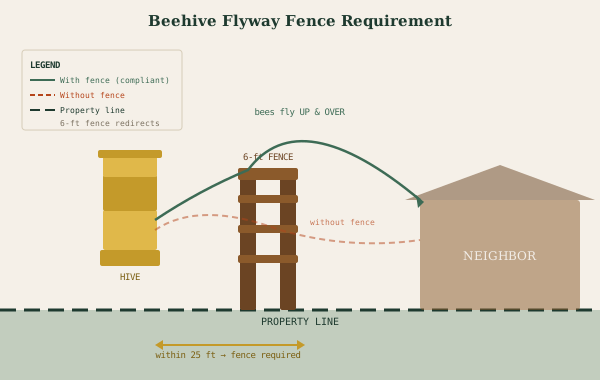
Flyway fence redirects bee flight paths — required when hive is within 25 ft of property line
The Flyway Fence Requirement
The most distinctive bee-specific ordinance requirement is the flyway fence. Many cities require that hive entrances facing a property line within a certain distance (typically 25 feet) must have a solid fence, hedge, or barrier at least 6 feet tall positioned to redirect bees upward before they cross the property line.
The science behind this: when bees are forced to fly upward before traveling, they typically stay at altitude over neighboring yards rather than flying at head height. This significantly reduces stinging incidents with neighbors and the public.
Hive Limits by Zoning Type
Zoning
Typical Hive Limit
Setback
Flyway Fence
Local Permit
Urban Residential
1–2 hives
10–25 ft
Often Required
Often
Suburban Residential
2–4 hives
10–20 ft
Sometimes
Sometimes
Rural Residential
4–10 hives
25 ft
Rarely
Rarely
Agricultural
Typically unlimited
50 ft
No
No
State registration is required separately in most states, regardless of local rules.
Some cities require formal neighbor notification as part of the permit process — typically written notice to adjacent property owners within 100–150 feet. Even where not required, notifying neighbors is strongly recommended. The vast majority of bee-related neighbor disputes arise from surprise, not the bees themselves. A conversation explaining your setup and providing your contact number if a swarm occurs prevents most problems.
Swarms are a natural part of hive reproduction and are not aggressive — a swarm without a hive has nothing to defend. However, a swarm landing on a neighbor's property is a neighbor complaint waiting to happen. Most beekeepers are prepared with a swarm capture box and can relocate a swarm within hours. Registered beekeepers are often contacted by local animal control as a resource for swarm calls. Keep your contact information current with your local beekeeping association.
Yes, significantly. Africanized honey bee (AHB) hybridization is a concern in the southern U.S. from California to Florida. Some states and localities prohibit beekeeping entirely in AHB-established zones, while others require certified Africanized-resistant queen replacement programs. If you're in California, Arizona, New Mexico, Texas, Nevada, Florida, or other AHB-present states, check with your state apiary inspector about specific requirements.
Yes, in many cities. The key is satisfying the setback and flyway fence requirements. A hive placed against a 6-foot solid fence on the back property line — with the entrance facing the fence so bees fly upward — can work on lots as small as 4,000 square feet in bee-friendly cities like Seattle, Denver, and Austin. The physical footprint of a hive is small; it's the bee flight path management that matters.
📚 Recommended Resource
Beekeeping for Beginners (2026 Edition)
Once your ordinance is clear, this #1 bestseller covers building your first hive, colony management, honey harvesting, and Varroa mite control. Includes a hive inspection checklist. Rated 4.7★ with 754+ reviews.
As an Amazon Associate, we earn from qualifying purchases at no additional cost to you.
Disclaimer: This page provides general informational guidance only. Ordinances vary by city and county and change frequently. Always verify with your local planning department before acquiring animals.